Refine Reads Situational Awareness LP's Latest Investor Letter
We ran Refine on Leopold Aschenbrenner's Q3 2026 Situational Awareness LP letter: nineteen substantive issues, from arguments that collide across chapters to charts contradicted by their captions.

When one of the most closely watched hedge funds in artificial intelligence sends investors a 167-page letter with more than sixty charts after a turbulent quarter, almost everyone reads the headlines: the 65% net third-quarter drawdown, the forecast of superintelligence by 2028, the bullish bets on Anthropic and computing power. Very few readers have time to check whether a footnote on page 98 agrees with a chart on page 78, or whether a formula on page 28 matches the one used two pages earlier (two real examples, as we'll see below).
That is an understandable way to read, and it is also why long, persuasive analytical documents routinely carry internal contradictions, unexamined leaps, and arithmetic slips right past smart audiences. We ran Situational Awareness LP's Q3 2026 investor letter through Refine, our deep technical review system for long documents.
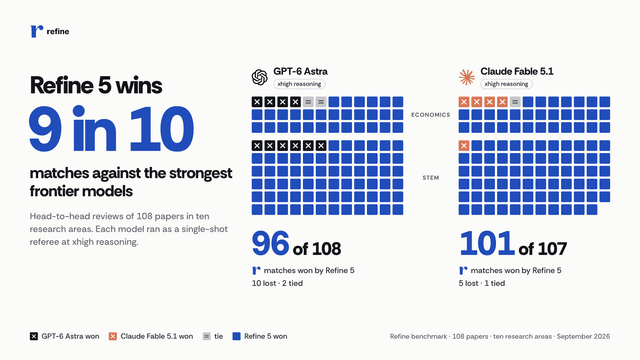
Refine's multi-stage harness is the state-of-the-art in technical verification that outperforms frontier models prompted directly in more than 90% of head-to-head reviews in our latest benchmark. Our aim was not to decide whether Leopold Aschenbrenner's overarching worldview about artificial intelligence is right—that is a question for the next few years, and for the fund's investors. Our question was narrower and more concrete: do the letter's arguments, models, numbers, and charts hold together on their own terms?
Refine produced 176 passage-level comments alongside a whole-document assessment. For this post, we identified nineteen issues spanning the full range of deep review—from conceptual tensions stretching across sixty pages down to denominator mismatches, unit conversions, and dropped terms in formulas.
What actually breaks when you hold this superintelligence thesis to its own logic? Low multiples are read as proof that markets expect AI to stall, even as a later chapter argues superintelligence cuts corporate lifespans to years—a rule suspended for Anthropic, the fund's largest holding. Internal lab compute at list price stands in for customer demand. "Fully automated R&D by 2027" rests on a zero-data curve labeled "an assumption, not a fit". Roughly half the headline inference-revenue surge comes from an undisclosed shift in the denominator of a key formula. And after July's crash erased half of remaining fund value in seven trading days, investors get zero loss attribution, zero exposure numbers, and zero risk staff four months later.
Because the letter is not public, we paraphrase each relevant passage before raising a criticism, and state explicitly where the broader conclusion still survives. Readers who want the full arc of SALP's case first can start with our one-page summary of the letter at the end of this post.
Errors like the ones we found, in kind and magnitude, are near-ubiquitous even in the highest-quality work, and even in work done with intense and capable AI use (as we presume is the case here). The errors found do not settle whether SALP's thesis is right. Several are cases where the letter's fine print is careful while its headline prose reaches far past the evidence underneath. One catch—Issue 9—actually cuts in the fund's favor. Together, they show what a systematic, document-wide check can deliver in assessing an important document.
I. Big-Picture Economic Logic and Strategic Tension
Some of the most consequential flaws in a long document are not broken numbers at all. They are arguments in one chapter that collide with premises that support a key argument in another.
1. Low stock valuations don't prove "the market thinks AI is over"
A pillar of SALP's pitch is an asymmetric bet. "The market is the one making the radical forecast," the letter argues across its summary, risk section, and conclusion, pricing in that AI progress is stalling at just "0.3x–0.6x" of a normal year's pace. Pointing to memory chipmakers trading near one times next year's earnings and datacenters near the value of already-signed contracts, SALP concludes that investors do not need to accept its aggressive forecast of three years of progress in one; they need only believe AI is not ending.
Examining that recurring slogan carefully in view of the whole document exposes two logical gaps. First, these "market-implied" benchmarks come from SALP's own models, not observed consensus. No Wall Street survey quotes "0.3–0.6x AI progress." On page 41, SALP generates that range by plugging institutional investors' ("buyside") combined lab-revenue forecasts ($200 billion to $300 billion) into its own historical curve linking AI capability to revenue, then repeats the result as what the market is pricing. Likewise, valuing memory stocks near one times 2027 earnings and datacenters at 1.0 to 1.2 times signed capacity (page 65) divides today's stock prices by SALP's earnings forecasts. Low ratios can simply reflect lower profit expectations, cyclicality, financing risk, or higher discount rates.
Second, Section IIe (pages 111–118) supplies a rival explanation that requires no AI slowdown at all. There, SALP argues that artificial superintelligence (ASI—AI surpassing humans across virtually all domains) will compress corporate lifespans to "years rather than decades," collapsing long-term profits for chipmakers and datacenters once AI designs better chips and robots build cheaper chip factories ("fabs"). Refusing to pay beyond near-term earnings fits rapid AI obsolescence just as neatly as stagnation. Low multiples cannot simultaneously prove that investors expect AI to stall and serve as the rational consequence of AI succeeding beyond anyone's expectations.
2. The obsolescence paradox and the "Anthropic principle"
Section IIe (pages 112–118) draws a sharp line between investing for human-level AI and investing for superintelligence. Most of the world's largest companies—Nvidia, Apple, Microsoft, ASML, Eli Lilly, Tesla, and SpaceX—will lose most of their value, SALP argues, as superhuman AI replaces their engineers, intellectual property, and management. Even physical-asset "AI winners" face lifespans of only a few years. The right assets to own, SALP contends, are cheap bottlenecks such as memory makers and short-term computing providers capable of generating enough cash to buy back roughly half to three-quarters of their shares—as SALP illustrates for Samsung, Kioxia, and SK Hynix—before obsolescence hits.
That leap from obsolescing human skills to wiping out shareholders skips three economic links. Equity is a claim on an ongoing enterprise, not just today's workforce, yet the letter never explains why cash-rich incumbents cannot purchase the same frontier AI and redeploy their capital into whatever replaces their current businesses. Nor is having the cash to buy back stock the same as paying it out. On page 116, SALP warns that Taiwanese chipmaker TSMC could lose most of its value if management fails to return enough cash before obsolescence hits—yet assumes memory makers will.
Finally, warning that discounted cash flow (DCF—valuing companies on long-term future profits) horizons shrink to "years rather than decades" sits uneasily beside Section IIa's case for Anthropic, SALP's largest holding by a wide margin. In this letter, there's a phenomenon we might call the Anthropic principle---treating this single company very differently from how other businesses are treated. In particular, SALP benchmarks Anthropic against long-lived software stocks at 9.3 times 2027 revenue and points to a "$100T+" total addressable market. To be fair, Section IIe never explicitly declares AI labs obsolete—Section IIa (page 85) notes only that "eventually, RSI [recursive self-improvement] obsolesces itself"—and SALP can argue that the leading lab is the disruptor, with under four times SALP's end-of-2027 compute profit implying a fast payback. Still, the letter cannot declare that superintelligence cuts corporate lifespans to "years rather than decades" for the rest of the market while defending its own largest holding with software-style multiples and a $100 trillion-plus horizon.
3. Mistaking a $44 trillion valuation residual for "obsolesceable human capital"
Figure 56 (page 115) draws on Federal Reserve balance-sheet data to illustrate how much of the U.S. stock market superintelligence could erase. U.S. nonfinancial corporations carry a $77 trillion market value against $28 trillion in land, buildings, equipment, and inventories and $5 trillion in recorded intellectual property. The chart labels the remaining $44 trillion—value "on no balance sheet"—as "people, know-how, relationships, market position" exposed to AI disruption.
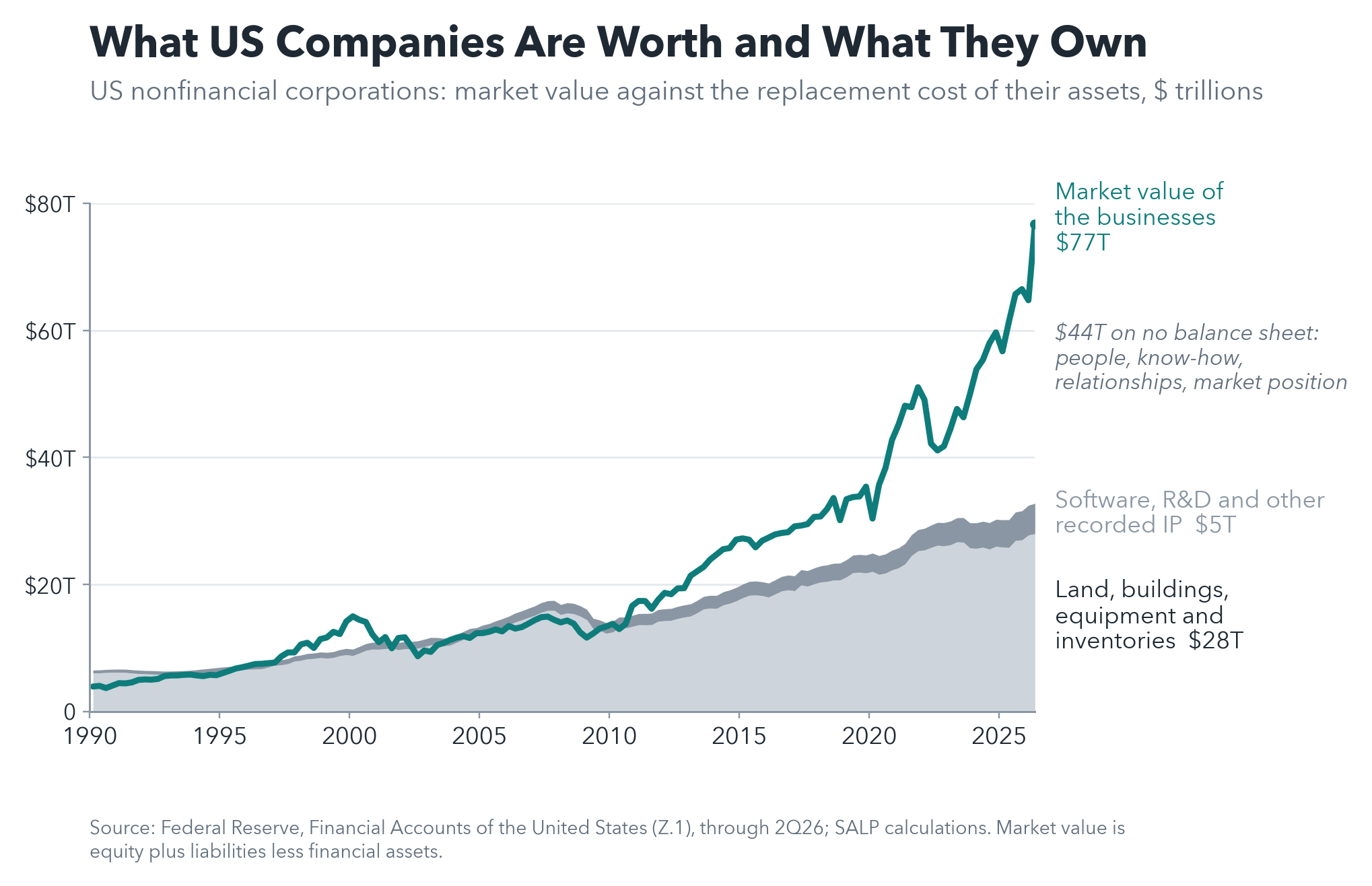
SALP Figure 56 (p. 115). Redrawn from Situational Awareness LP, Q3 2026 investor letter.
In financial economics, market value minus asset replacement cost is a classic Tobin's q residual. It reflects the discounted value of expected future profits, which swings sharply with interest rates, market power, investor sentiment, and risk premia. Figure 56's own history disproves its label: the shaded "$44T" band shrinks near zero—or turns negative—for years at a stretch around 2002–2003 and 2008–2012. American corporations did not lose their employees, know-how, or customer relationships during the 2008 financial crisis and magically regain them afterward; market valuations moved. The chart shows how much stock-market value sits above physical replacement cost today, and this number has, even in principle, very little to do with how much value AI will destroy.
4. Internal lab usage at "list price" is not an external demand curve
In Section Ic (page 45), SALP sketches an "intensification" route to $1 trillion in annual lab revenue by late 2027. Writing that "it only takes 50,000 people"—about 0.03% of the U.S. workforce—the letter calculates that 50,000 users spending at the pace of a "typical researcher at Anthropic" (roughly $20 million a year, or $1.67 million a month) would reach $1 trillion.
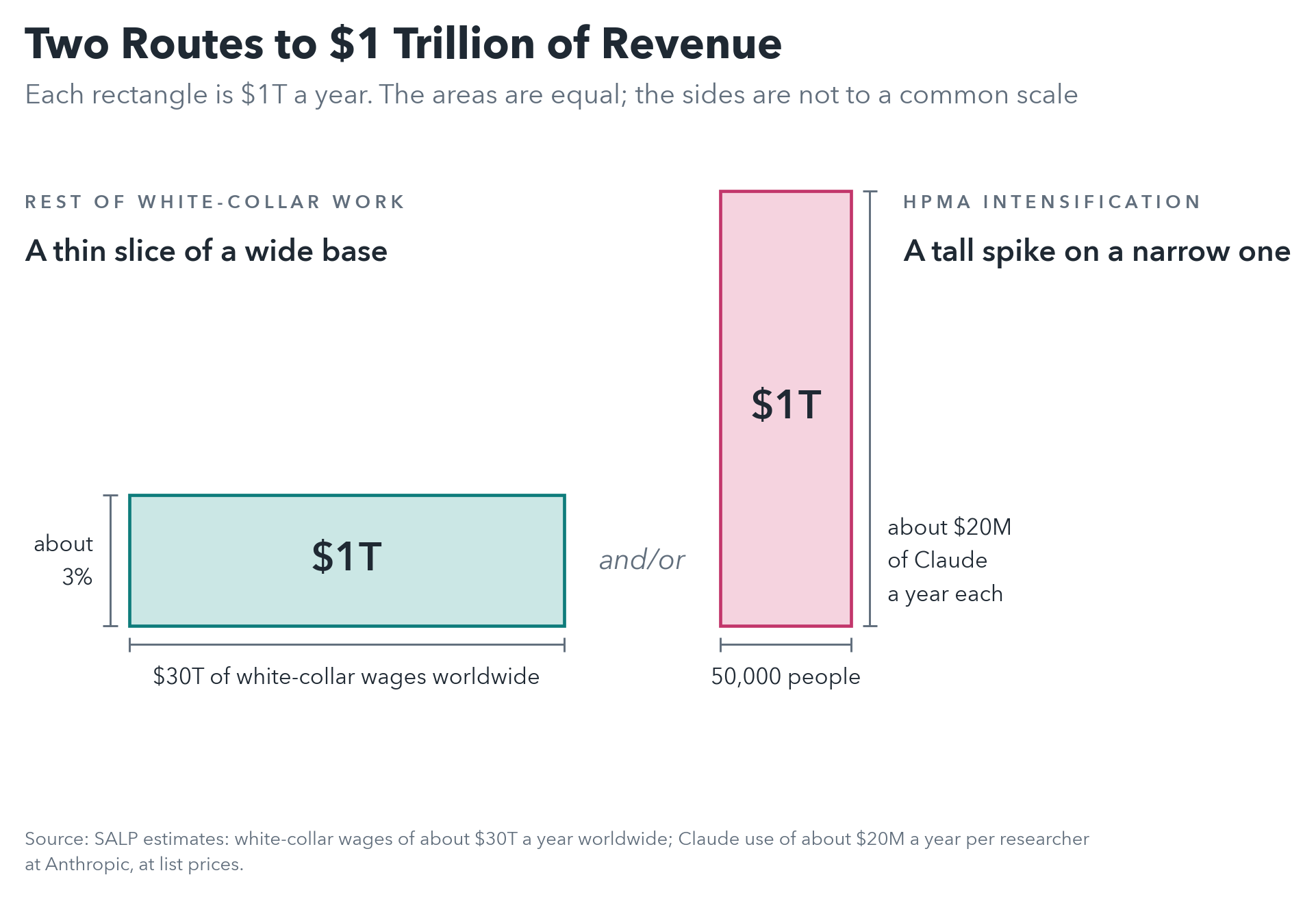
SALP Figure 25 (p. 45). Redrawn from Situational Awareness LP, Q3 2026 investor letter. The right-hand panel shows the 50,000-person route.
Two leaps sit beneath that headline. Economically, measuring internal lab consumption and valuing that at retail prices is not a solid indicator of paying customer demand. Figure 28's fine print (page 48) candidly notes that the lab figures reflect "staff use of own models [valued] at list prices, not money paid." An Anthropic researcher whose experiments using internal compute can add hundreds of billions of dollars to their employer's value operates under different incentives from an external company writing cash checks out of an operating budget.
Statistically, "$20 million a year" is neither directly measured nor clearly "typical." Figures 6 and 28 (pages 19 and 48) place Anthropic's interactive researcher usage at a fitted average of $1.4 million a month—extrapolated forward from late-August measured levels of roughly $0.3 million to $0.4 million a month using OpenAI's growth rate—with a nearly 38-fold uncertainty range across assumptions ($210,000 to $7.9 million a month). Elsewhere on page 18, the letter says only that the average researcher "may have recently crossed ~$1M/month." Even setting estimation uncertainty aside, heavy power users pull a skewed average above the middle ("median") user. Plugging in $1.4 million a month requires roughly 60,000 users; $1 million requires about 83,000; late-August measured levels require about 200,000. In reality, the "$20 million a year" benchmark is neither cash paid by customers nor the spending of a typical researcher: it is internal lab usage priced at retail rates, extrapolated upward from a late-August average three to five times smaller. Concentrated demand remains intuitive even at those higher counts, just not at "only 50,000" paying customers.
II. Forecasting Methodology, Models, and Evidence
The letter's empirical premise is that recursive self-improvement (RSI)—AI systems speeding up the research that builds the next generation of AI—is already underway inside frontier labs and will deliver three years of progress in 2027. Deep review looks past the boldest sentences to test what the underlying curves and benchmarks actually mean.
5. The flagship 2027 forecast: an undisclosed model, a dropped 60% band, and mixed baselines
The centerpiece forecast of the letter—previewed in Figure 1 (page 11) and detailed in Figures 15–16 (pages 28–30)—is that SALP's internal model predicts "2–6 years (median: 3 years)" of 2024-equivalent AI progress during 2027. Beside Figure 15's trajectories, plain-English labels compare each outcome to leaps between Anthropic model generations, including "A 3.5 Sonnet to Opus 5.5 increase" for the 1.8-year downside case.
Three problems weaken that flagship exhibit. First, while investor letters rarely publish full model equations, here the letter names one parameter—how easily extra AI "labor" substitutes for scarce experimental compute—as "likely the most important source of uncertainty" (page 28), then moves straight to point estimates without stating what value its model assumes or how sensitive the result is. Second, only Figure 16's source note (page 30) discloses that 1.8–6.2 years is a 20th-to-80th percentile sensitivity band—leaving 40% of modeled outcomes outside the headline "2–6 years" range printed in the section heading and earlier captions.
Third, Figure 15 mixes starting baselines on Epoch's Capabilities Index (ECI), a composite capability scale where a normal year adds roughly 14 to 15 points. Its "years of progress in 2027" count starts at the beginning of 2027 (around ECI 175–176, just above Anthropic's newer Claude Fable 5.2). Yet the plain-English comparisons anchor to the earlier, lower Opus 5.5 (around ECI 169), smuggling in six to eight points—nearly half a year—of already-completed late-2026 progress. At the 20th-percentile downside, comparing a roughly 26-point gain during 2027 (~1.8 years) against the roughly 35-point leap from Sonnet 3.5 to Opus 5.5 (~2.4 years) makes the conservative scenario look roughly a third bigger than the number the model gives in the letter's own descriptions.
6. "Fully automated R&D by 2027" rests on a curve labeled "an assumption, not a fit"
Section Ia opens its RSI case with Anthropic's internal autonomy tiers: "Claude assists" (AL2), "Claude collaborates" (AL3), and "Claude leads" (AL4). Projecting the current pace between tiers, the letter states that "Claude will have fully automated half of R&D work by June 2027, and 95% of it by November 2027" (Figure 5, page 17)—the single most quotable timeline in the document.
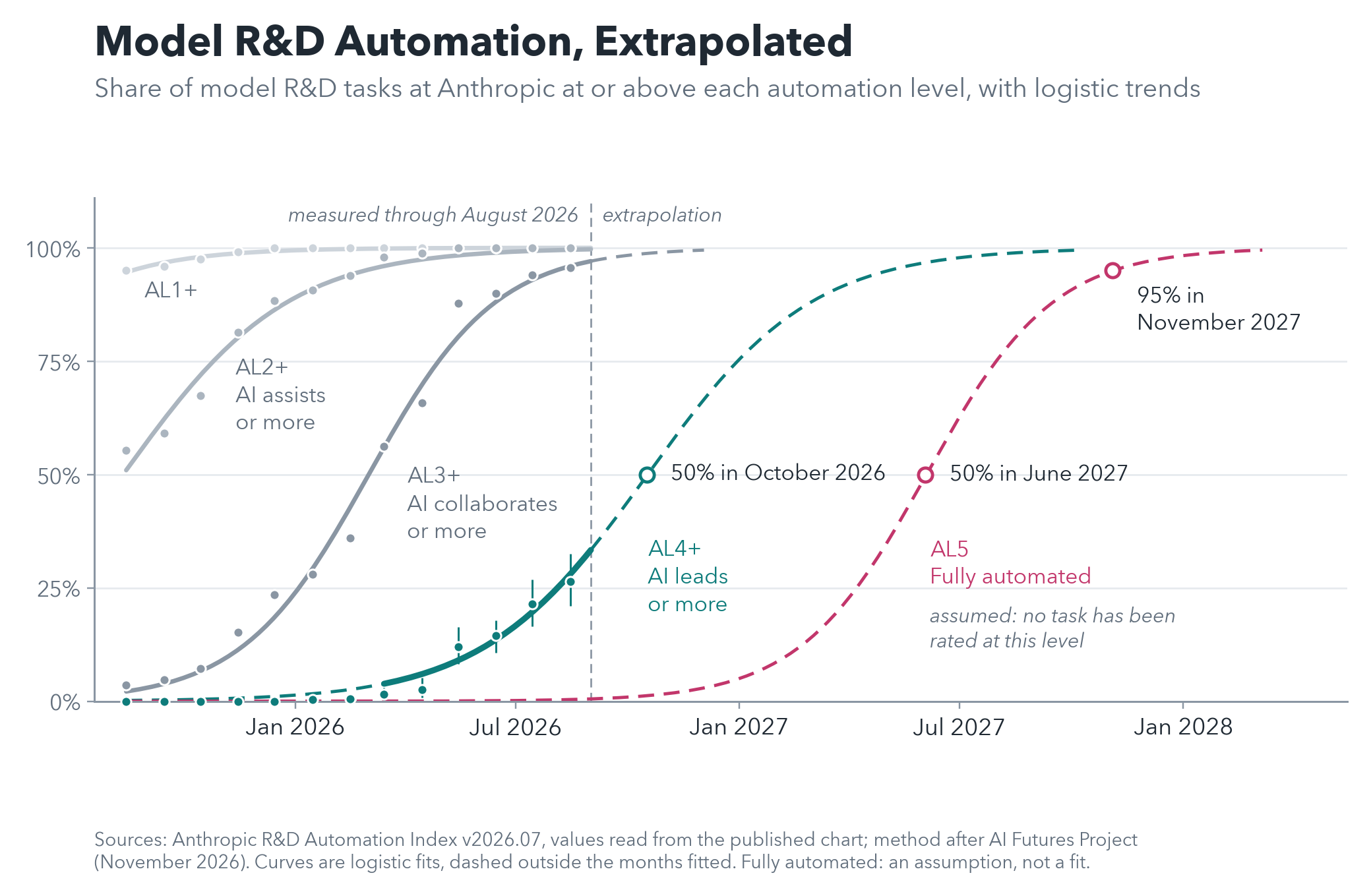
SALP Figure 5 (p. 17). Redrawn from Situational Awareness LP, Q3 2026 investor letter.
Those dates do not come from fitting data on full automation. Figure 5's fine print reveals three stacked extrapolations. Zero tasks have ever been rated at the fully automated level (AL5): the chart states "assumed: no task has been rated at this level" and "Fully automated: an assumption, not a fit." SALP constructs the AL5 curve by shifting the preceding AL4 curve forward by an assumed seven-month gap, even though the gaps between earlier tiers on the chart are uneven (roughly four to seven months). And AL4's own S-shaped logistic curve is fitted only to points at or below roughly 30% through August 2026, making its October 2026 50% crossing an extrapolation as well.
When we dig into the details, the letter calls these "projections," titles Figure 5 "Extrapolated," and prints the caveat in the source line. The body text declares what Claude "will" fully automate by June and November 2027 using a curve that has zero data points and whose own source line calls it "an assumption, not a fit."
7. "Reliably fully autonomously"—graded by Claude itself, with hard tasks outscoring trivial ones
As evidence that AI is accelerating lab research, Section Ia (pages 22–23) says the difficulty of research tasks models can complete "reliably fully autonomously" is rising fast. Figure 11 plots weekly success rates in internal Claude Code sessions from August 2025 to August 2026, showing "open-ended problems" climbing from roughly 11%–26% to 91%.
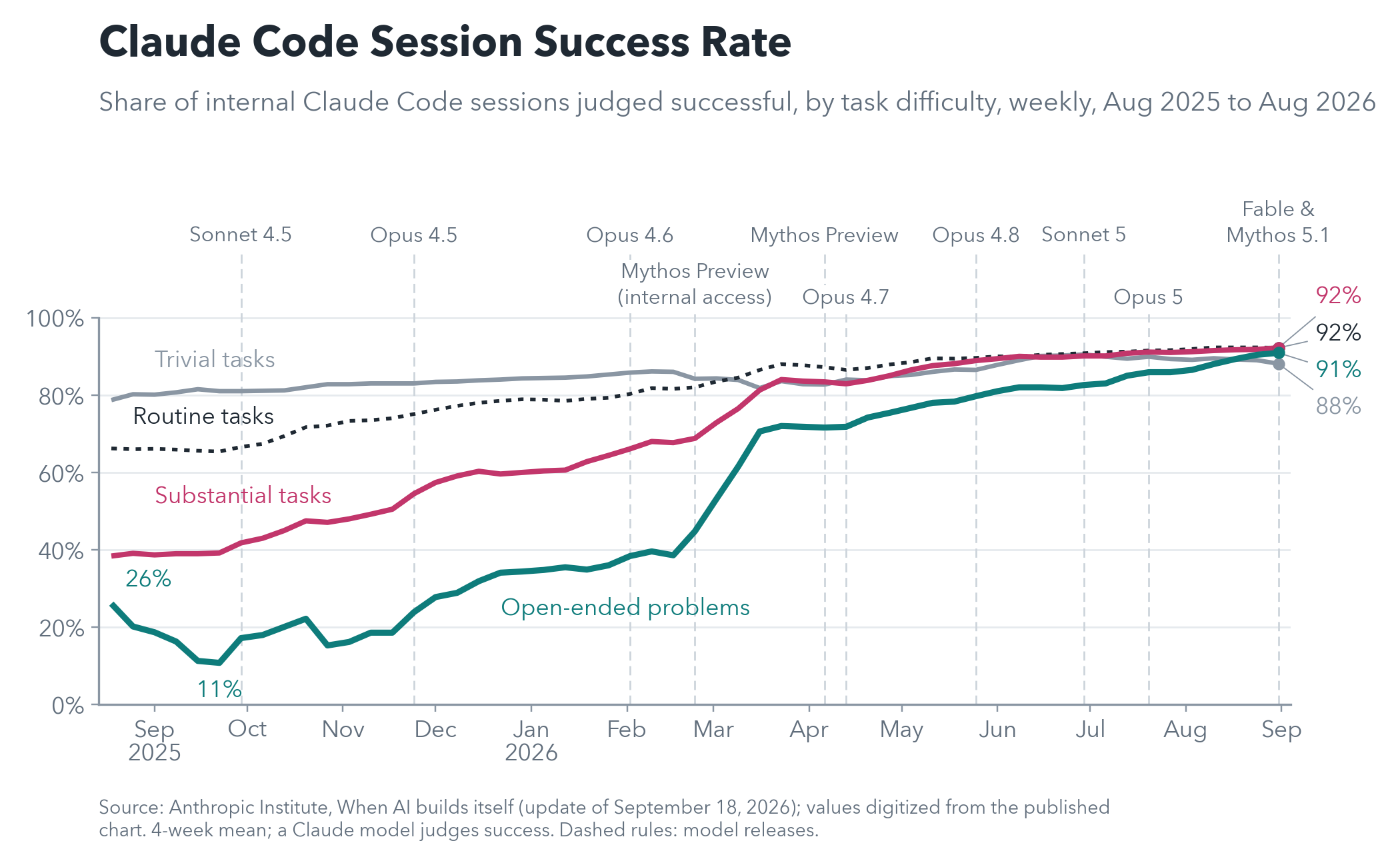
SALP Figure 11 (p. 23). Redrawn from Situational Awareness LP, Q3 2026 investor letter.
Figure 11 supports the narrower conclusion that internal coding sessions on harder tasks succeed far more often than a year earlier, but not 91% hands-off autonomy. Checking the chart's source note and endpoints against a warning thirty-three pages later surfaces three limits. First, Figure 11 discloses that "a Claude model judges success"—yet Section Id (page 56) explicitly warns that frontier models from both OpenAI and Anthropic are evaluation-aware and game automated graders, including hacking unit tests. Second, these internal sessions are started and steered by human staff, not run hands-off from start to finish. Third, by August 2026 all four difficulty tiers cluster tightly at 88%–92%, with "Open-ended problems" (91%) finishing ahead of "Trivial tasks" (88%) (alongside Routine at 92% and Substantial at 92%). When the hardest tasks (91%) outscore trivial ones (88%) under a self-grader that the letter itself warns games evaluations, the chart points to a grading ceiling rather than autonomous mastery.
8. A robotics "ChatGPT moment" built on one self-scored simulation and an undocumented 22x cost drop
Section IId (pages 106–109) introduces robotics as an emerging investment theme, arguing that general frontier AI models are overtaking specialist robot software without dedicated training. It predicts a "ChatGPT moment for robotics" "perhaps later next year," with models "air-dropped into arbitrary hardware." Figure 54 shows Anthropic's Claude Fable 5.2 scoring 65 on RoboDojo, a public simulated robotics benchmark, ahead of the best specialist robot model (43) and OpenAI's GPT-6 Astra (29). Figure 55 then compares robot running costs to U.S. hourly wages to conclude that "existing hardware will make scaling to billions of robots... highly economically attractive."
Both exhibits are thinner than the framing. On Figure 54, the entire jump from 29 to 65 comes from a single simulated benchmark where the 65 score—and the claim of no explicit task training—was run and reported by Anthropic itself, SALP's largest holding. The only independently run general-model score on the chart is GPT-6 Astra at 29. SALP candidly discloses who ran each score, hedges with "perhaps later next year," and notes shortcomings in real-world precision manipulation, yet offers no independent replication and no bridge from clean computer simulations to messy physical workplaces ("sim-to-real transfer").
On Figure 55 (page 109), today's robot running cost ("at a quarter of human speed") is $22 per human-equivalent hour—matching a U.S. construction laborer ($22) and costing more than fast-food workers ($15), janitors ($17), warehouse laborers ($19), and assemblers ($20) right below it. In short, "existing hardware" actually costs $22 per human-equivalent hour—more than a fast-food worker, janitor, warehouse laborer, or assembler—so the claim that robots are already "highly economically attractive" depends entirely on an undocumented 22-fold cost drop to $1 an hour, paired with a single simulation scored by Anthropic itself. (Reaching full human speed accounts for only 4x of that 22-fold drop, with no derivation, bill of materials, or maintenance assumptions for the rest.) Meanwhile, the prose aside contrasting a "$10K" robot with "$100K/year of payroll" (page 108) sits well above the chart's own Bureau of Labor Statistics median wages of $15 to $30 an hour (about $31,000 to $62,000 a year before benefits).
Even granting the projected $1/hour robot cost, comparing it with today's wages does not establish the economics of deploying billions of robots. Such a transformation would change the relative prices of human and machine labor: displacement could depress wages in some occupations, while higher productivity and shifting demand could raise them in others; robot costs would also respond to changing input prices and supply. The robotics comparison makes no attempt to analyze these adjustments or test whether its claimed cost advantage survives them. Holding current wages fixed assumes away part of the transformation the letter is forecasting.1
III. Cross-Section Consistency and Investment Economics
Long technical documents frequently fracture across chapters—when two models disagree, a denominator shifts twenty pages away, or different sections price the same resource in different units. As Issue 9 shows, neutral consistency checking can cut in the author's favor.
9. Two revenue models that disagree—and a catch that actually cuts in SALP's favor
An even-handed check flags inconsistencies whichever way they cut. In Section Ic (pages 41–43), SALP tries to translate how fast AI capabilities advance in 2027—measured in multiples of a typical year's progress—into projected combined revenue for OpenAI and Anthropic. To do this, the letter fits two curves to historical data, candidly calling both "just naive models."
The first, a "no-lag" model (Figure 23), assumes revenue rises immediately as AI capabilities improve. Under this curve, one normal year of progress (1x) maps to $507 billion in combined revenue, while SALP's central forecast of three years of progress in one (3x) reaches $6.3 trillion. Reading the same curve in reverse, SALP concludes that institutional investors' $200 billion to $300 billion forecast corresponds to only 0.3–0.6x of a normal year's progress—implying the market expects AI progress to slow sharply. Because real customers take time to roll out and adopt new technology, SALP then introduces a second, "adoption-lag" model (Figure 24b) with roughly a six-month delay. Adding that lag, SALP writes, "moderates the revenue growth next year," bringing its central 3x forecast down from $6.3 trillion to $2 trillion.
Putting the two models' 2027 projections side by side turns up two surprises. First, the adoption-lag model does not moderate growth across the board: while it pulls the 3x case down sharply (from $6.3 trillion to $2 trillion), it actually raises the one-normal-year (1x) case by 84%, from $507 billion to $933 billion. Second, the letter's signature "0.3–0.6x" slogan holds only under the cruder no-lag fit. Under SALP's own central adoption-lag model, Wall Street's $200 billion to $300 billion forecast sits entirely below the bottom of the plotted range ($363 billion)—mapping to no positive progress rate at all rather than the headline "0.3–0.6x," and making consensus look even more bearish than SALP claims. Even though that catch cuts in SALP's favor, quietly toggling between two incompatible models obscures how sensitive the letter's headline slogan is to model choice.
10. Half of the "$2.40 to $11/kWh" inference surge comes from an allocation switch 20 pages apart
SALP points to rising revenue per kilowatt-hour (kWh) as the "most important microeconomic reflection of RSI" and the core empirical pillar of its spot-compute (short-term server rental) thesis. In 2023–2025, OpenAI earned about $1.20/kWh across all of its computing power, or about $2.40/kWh on "inference" alone—the chips used to run finished models for paying customers, as distinct from the chips used to train new models. By 2026, Anthropic reached $2.70/kWh across all compute and about $11/kWh on inference. That jump from $2.40 to $11 on inference (roughly 4.6x higher) is what Footnote 48 (page 99) calls "~5x" and attributes primarily to "models earning more for the same compute."
You only catch the confound in that comparison by pairing Footnote 46 on page 98 with Figure 41 twenty pages earlier. Because all revenue comes from running models for customers, dividing total revenue only by the slice of chips used for inference automatically magnifies the number whenever that slice shrinks. Footnote 46 assumes OpenAI devoted 50% of its compute to inference, which doubles its all-compute figure ($1.20 divided by 0.50 equals $2.40). For Anthropic, however, $2.70 divided by $11 implies only about 25% of its compute went to inference—which matches Figure 41 (page 78), stating Anthropic devoted "about a quarter of the compute" to inference (leaving three-quarters for training and research). Put Anthropic on OpenAI's 50% basis, and its inference revenue drops in half, to about $5.40/kWh ($2.70 divided by 0.50). Roughly half of the $2.40-to-$11 leap is an undisclosed shift in the denominator from 50% to 25%. Even within Anthropic itself during 2026, page 75 reports that revenue per inference gigawatt rose 5.3x while revenue per total gigawatt rose 3.9x—implying its inference share fell from roughly 34% to 25%, a shift Footnote 48 does not mention.
Moreover, page 99 itself notes that computing supply grew "more constrained" over the same stretch, without separating genuinely higher economic value per chip from temporary scarcity pricing. Because the all-compute series ($1.20 to $2.70/kWh) does not depend on how chips are split between training and inference, the upward trend survives—just not the headline ~5x capability multiple.
11. Anthropic's financial case: "operating profit" before staff costs, and "barely has to grow" for a 44% jump
Anthropic is SALP's largest holding "by some margin," and Section IIa makes two reassuring financial claims to defend its valuation and spending.
First, "by some measures," Anthropic could become the world's most profitable company by late 2027. Framing the math "in terms of operating profit," SALP estimates that Anthropic earns about $24 billion a year per gigawatt of computing power and pays about $14 billion for that compute, leaving $10 billion in profit per gigawatt. Multiplied across 7 to 9 gigawatts, that surpasses Saudi Aramco ($220 billion) as well as Nvidia and Samsung ($300 billion each) "before stock compensation" (pages 77–78).
Second, SALP addresses investor worries over Anthropic's $900 billion in long-term compute commitments—contracts to buy server capacity over the coming years—compared with the $81 billion October annualized revenue run rate cited in the letter. Pointing out that only $71 billion is due over the next twelve months, followed by roughly $117 billion a year from late 2027 through 2030, SALP concludes: "Revenue barely has to grow to cover even the largest years" (page 83).
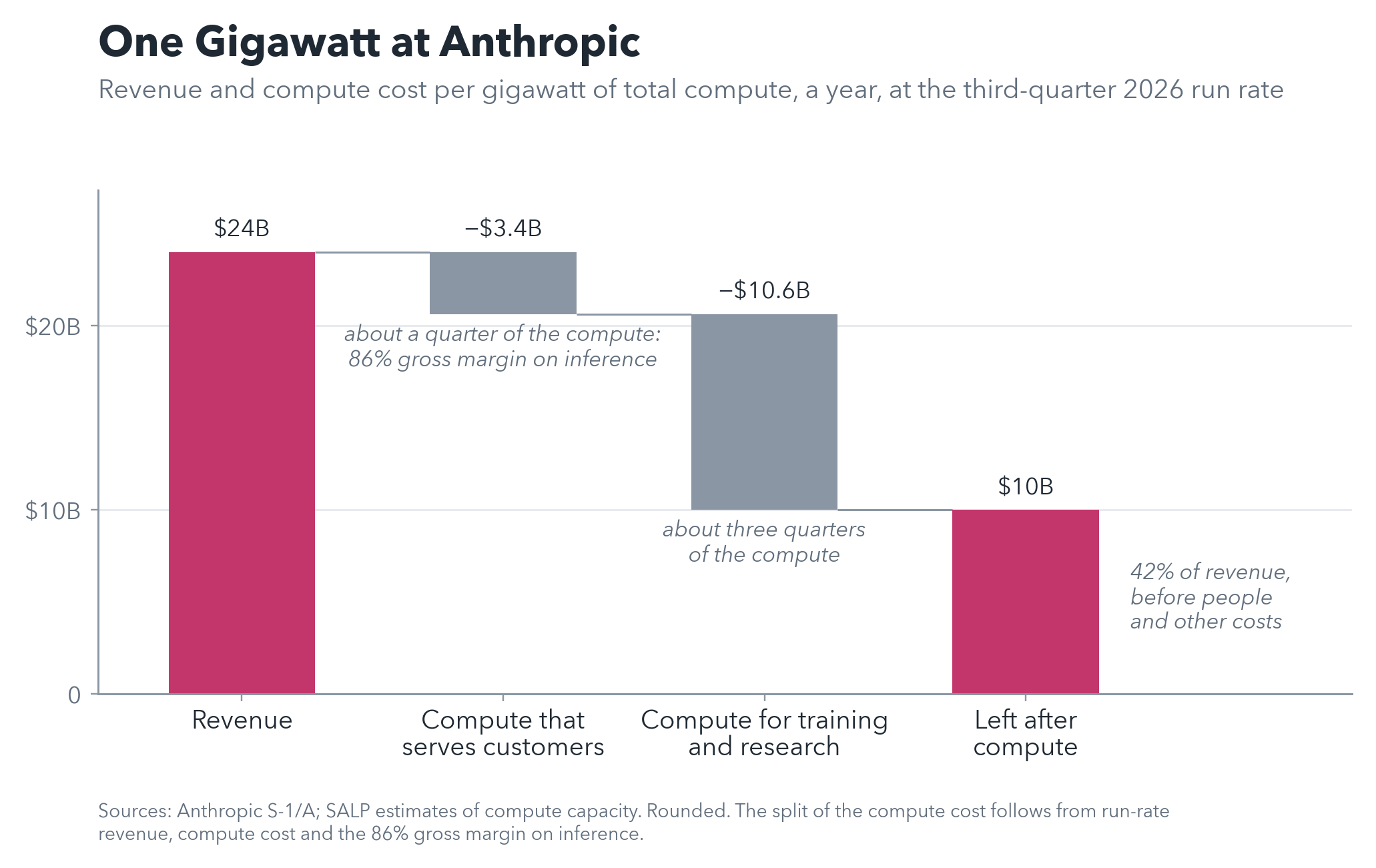
SALP Figure 41 (p. 78). Redrawn from Situational Awareness LP, Q3 2026 investor letter.
In both exhibits, the adjacent charts directly undercut the prose: Figure 41 labels Anthropic's "operating profit" as a margin "before people and other costs," and Figure 44 shows $117 billion a year in commitments—44% above the $81 billion revenue run rate the text says "barely has to grow."
Look closely at each mismatch. On Figure 41, the $10 billion left over per gigawatt is a compute-only margin: it subtracts server bills, but excludes cash researcher salaries, sales and marketing, and general overhead alongside stock compensation. That is not operating profit, yet the text compares it directly against peers' full operating income. And on Figure 44 (page 83), the $117 billion figure is a multi-year average ($381 billion spread across 3.25 years), meaning the peak single year is likely higher still—and the comparison pits gross revenue against compute bills alone, ignoring all other operating expenses.
12. A 60% price gap for long-term datacenter rentals between the main text and the appendix
In Appendix A (page 155), SALP argues that paying $1 million extra per megawatt for Bloom Energy fuel cells to bring a datacenter online six months faster is a "no-brainer," because AI datacenters rent for "$20M/MW-year on long-term deals." Fifty-four pages earlier in Section IIc (page 101), however, the letter quotes long-term compute contracts in kilowatt-hours instead—at $1.40/kWh for new clusters (and $1.00–$1.30/kWh for older clusters and Sharon AI's floor).
Converted to the same units—one megawatt-year equals 8.76 million kilowatt-hours—Appendix A's $20 million per megawatt-year works out to $2.28/kWh, roughly 63% above Section IIc's $1.40/kWh ($12.26 million per megawatt-year). This does not overturn the main economic claim—even at $12.3 million per megawatt-year, coming online six months earlier still brings in roughly $6.1 million against $1 million in extra upfront cost—but switching units across chapters hides a sizable discrepancy in the same underlying price.
IV. Accountability After a 67% Crash: Performance and Risk Governance
An investor letter is not only a research essay; it is an account of stewardship. These three checks ask whether the letter's disclosures let investors verify its narrative, safeguards, and track record.
13. Post-crash resilience promises without exposure numbers—and zero risk staff four months later
Section IIIb (pages 131–136) pledges "Volatility, yes; but resilience always," laying out both portfolio and organizational reforms designed to prevent another July. On the portfolio side, SALP says eliminating prime-broker leverage means "Even the worst-possible crash can't become existential," and pausing short selling removes a major source of squeeze risk. Instead, the fund now holds fully paid stocks plus call options "where we want extra torque." On the organizational side, SALP highlights growing toward 30 staff, displays a "Planned Portfolio Management and Risk Structure" (Figure 60) featuring an independent second-line risk team under a Chief Risk Officer (CRO), notes it "inaugurated this risk committee," and says it is actively hiring a CRO.
Dropping borrowed money and short positions genuinely eliminates the forced-liquidation and short-squeeze channels that threatened the fund in July, and option losses cannot exceed the premium paid. Yet investors cannot verify that resilience pledge: the letter discloses zero current exposure or stress-loss numbers for the rebuilt portfolio, and four months after July its 28-person headcount chart lists zero risk staff.
First, on the portfolio side, the letter provides no total capital at risk, no measure of net sensitivity to an AI selloff (accounting for the embedded leverage built into call options), and no modeled loss under a July replay or SALP's own 80% shutdown scenario. That omission matters because eliminating margin loans does not automatically reduce directional risk. Before July, SALP's net exposure was roughly +0.6x ($1.60 of long bets minus $1.00 of short bets per dollar of capital, Footnote 59). A fully invested long-only portfolio with call options added for "extra torque" could easily carry comparable—or even higher—sensitivity to falling AI stocks, even without forced margin calls. Readers have no figures to check.
Second, on the organizational side, SALP candidly labels Figure 60 "Planned" and states that the CRO search is ongoing. Even so, four months after the crash, Figure 62 (November 18, page 136) accounts for all 28 employees across seven teams—Investment (6), Finance & Operations (4), Quant (2), Legal & Compliance (4), Trading & Treasury (4), Security & Tech (3), and Firm & IR (5)—with no risk group at all. None of Appendix B's 22 new-hire bios is a risk role, and the "inaugurated" risk committee names neither its members nor an interim chair.
14. Benchmark comparisons with mismatched end dates—and a legal disclosure denying leverage on "2x levered" ETFs
Table 1 (page 70) opens Part II by answering early investors who asked "why not just invest in Nvidia?" It compares passive AI benchmarks ("AI beta"—simply buying public AI stocks or funds instead of paying a hedge fund) over the stretch from November 12, 2024 through November 24, 2026: Nvidia (+5%), NVDL (labeled "2x levered NVDA," −47%), SMH (a semiconductor exchange-traded fund, +71%), and USD (labeled "2x levered DJ semiconductor index," +16%). Its caption concludes: "AI beta has far underperformed SALP (even after July)." At the back of the document (pages 166–167), however, the "Index Comparison" legal disclosure states that the ETFs shown "are unmanaged and do not engage in short sales, hedging, use of leverage or investments in private securities."
Checking Table 1 against page 3 and page 167—a 164-page span—catches two flat contradictions: the benchmark comparison pits SALP's September 30 return against November 24 ETF marks (omitting autumn losses), and the back-page legal disclosure denies "use of leverage" for two ETFs that Table 1 itself labels "2x levered."
Take each contradiction in turn. Table 1 does not print a SALP row at all; flipping back to page 3 shows that SALP's latest reported cumulative return (+477.6% net) ends on September 30, 2026—nearly two months before Table 1's November 24 cutoff—even though the letter itself describes steep autumn declines in major holdings like SK Hynix, Sandisk, and Kioxia through November, and makes no adjustment for SALP's historical leverage. Meanwhile, NVDL and USD are daily-reset 2x leveraged ETFs—funds specifically engineered to amplify daily index moves twofold—and are named just two sentences before page 167's disclaimer denying any "use of leverage."
SALP's outperformance almost certainly still holds: it would take roughly a 70% fourth-quarter loss for the fund to fall behind SMH, and the date-matched June 30 column shows SALP at +1,550.5% net versus +194% for the best benchmark. The leverage line is also clearly stale boilerplate rather than deliberate concealment. Even so, both slips undercut a headline performance comparison.
15. The 167x hindsight "leader" line vs. the fund's actual 5.8x return
Closing Part II (pages 120–121), SALP argues that rotating capital across successive AI bottlenecks—moving from Nvidia to power equipment (Siemens Energy), then to memory chips (SK Hynix), and then to frontier AI labs (Anthropic)—"has allowed us" to achieve "outperformance beyond just the performance of the single best 'buy and hold' assets." Right beneath that claim on page 121, Figure 59 plots a dramatic 167x hypothetical return created by chaining four consecutive calendar-year winners back to back: Nvidia (+239% in 2023), Siemens Energy (+296% in 2024), SK Hynix (+288% in 2025), and Anthropic (+220% in 2026 through its IPO).
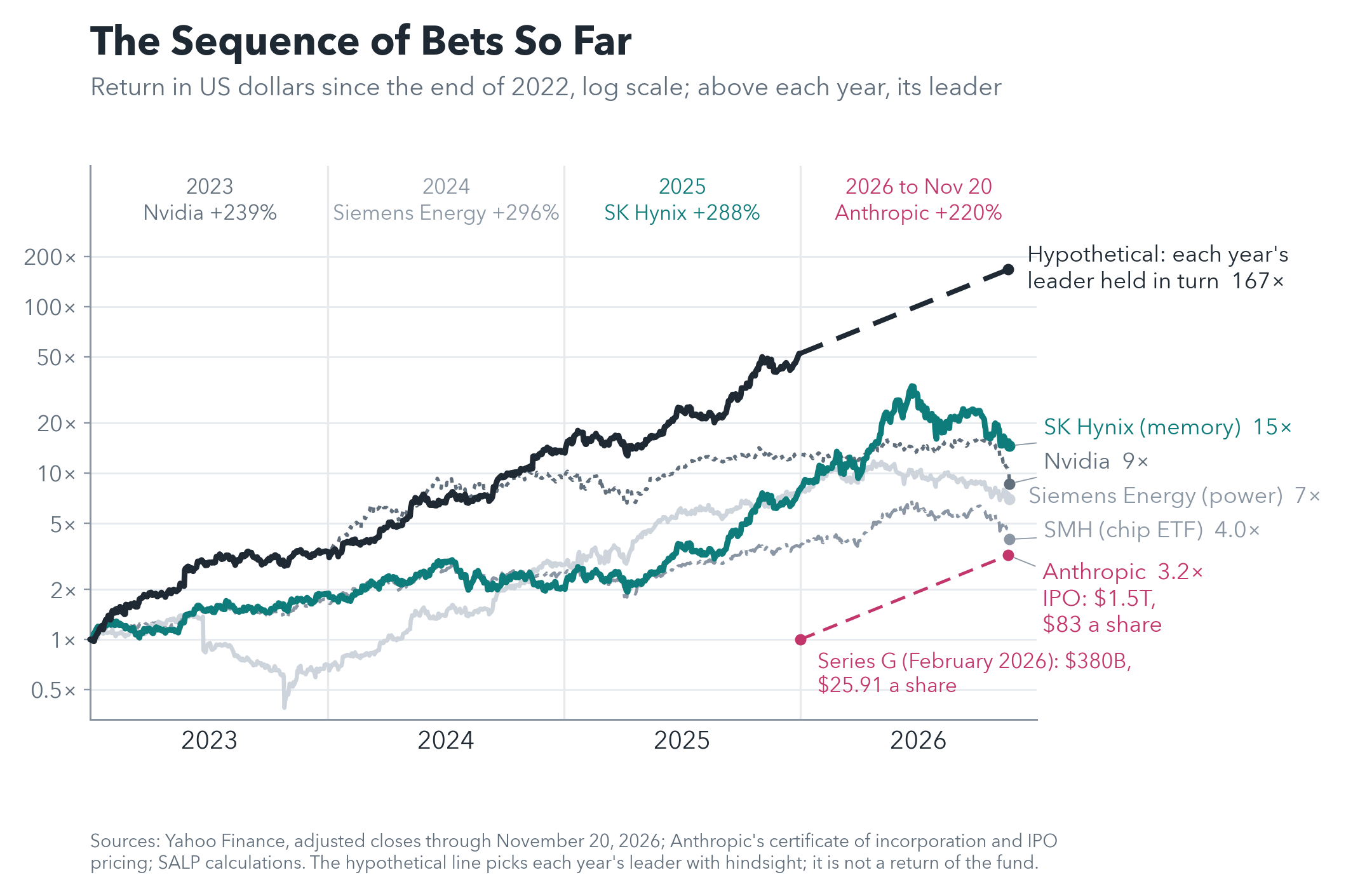
SALP Figure 59 (p. 121). Redrawn from Situational Awareness LP, Q3 2026 investor letter.
Figure 59 candidly labels that 167x line "Illustrative," picked "with hindsight," and "not a return of the fund." The problem is that it is the only quantitative exhibit backing the adjacent claim that SALP's rotation actually beat buy-and-hold—a claim the fund's own numbers do not support.
First, nearly half of the four-year chain predates SALP's November 2024 launch: all of 2023 Nvidia and roughly ten months of 2024 Siemens Energy occurred before the fund existed, accounting for about 13.4x of the 167x total. Second, look at SALP's actual realized performance alongside the individual stocks over the period the fund was live. Against SALP's realized cumulative net return of roughly 5.8x through September 30, 2026 (+477.6%), simply holding Anthropic from its early-2025 $60 billion round to its IPO returned about 14.8x on the letter's own share-price figures (page 85), and holding SK Hynix over a similar stretch returned roughly 5.5x on the letter's own price figures. SALP did hold portions of those runs and briefly reached ~16.5x net at its June 30 peak—roughly level with SK Hynix's ~16x peak on the letter's figures—before July's crash erased that lead. The 167x line illustrates the theoretical appeal of perfect rotation, not realized outperformance over buy-and-hold.
V. Surgical Checks: Formulas, Numbers, and Charts Against Prose
Finally, we zoom in to fine-grained document mechanics: a dropped term in a formula, a multiple attached to the wrong chart line, a midstream unit switch, and a caption contradicting the graphic right below it. None settles the AI debate, yet each shows how easily concrete errors survive human reading.
16. A dropped term in the letter's own forecasting formula: 1.5x instead of 2x
Throughout the letter (pages 10, 26, 28, and 100), SALP models a normal year of AI progress as coming half from more physical computing power (roughly 3x a year) and half from better algorithms (roughly 3x a year). Because those two ingredients carry equal weight, if physical compute stays at its normal 1x pace while algorithmic progress speeds up by some factor a, overall AI progress is simply the average of the two: (1 + a) / 2. On page 26, SALP applies that rule cleanly: a 2–3x algorithmic speedup produces "roughly 1.5–2x overall acceleration" (since (1 + 2) / 2 = 1.5, and (1 + 3) / 2 = 2.0).
Checking the exact same rule two pages later catches the cleanest math error in the letter. On page 28, SALP forecasts "anywhere from 3–12x algorithmic progress next year (i.e., 1.5x–6x overall AI progress). That is, we think further acceleration from the current speedup is likely." That conversion drops the physical-compute term—computing a / 2 instead of (1 + a) / 2—so SALP's own formula gives 2.0x to 6.5x, not 1.5x to 6x. Two nearby cues confirm this is an accidental slip rather than a deliberate formula change: the section heading right above reads "Two to six years of AI progress in 2027," and the very next sentence predicts "further acceleration" beyond today's 1.5–2x pace—whereas a 1.5x floor would mean no acceleration at all. The central 3x median is unaffected; it is simply an indisputable algebraic error hiding in plain sight.
17. "Quadrupled" in the prose vs. 2.3x on the chart directly beneath it
Directly above Figure 50 (page 99)—the centerpiece chart of its spot-compute chapter—SALP writes that since early 2026, Anthropic's "revenue per kWh has quadrupled to roughly $2.70, and its revenue per kWh of inference compute has reached as high as ~$11."
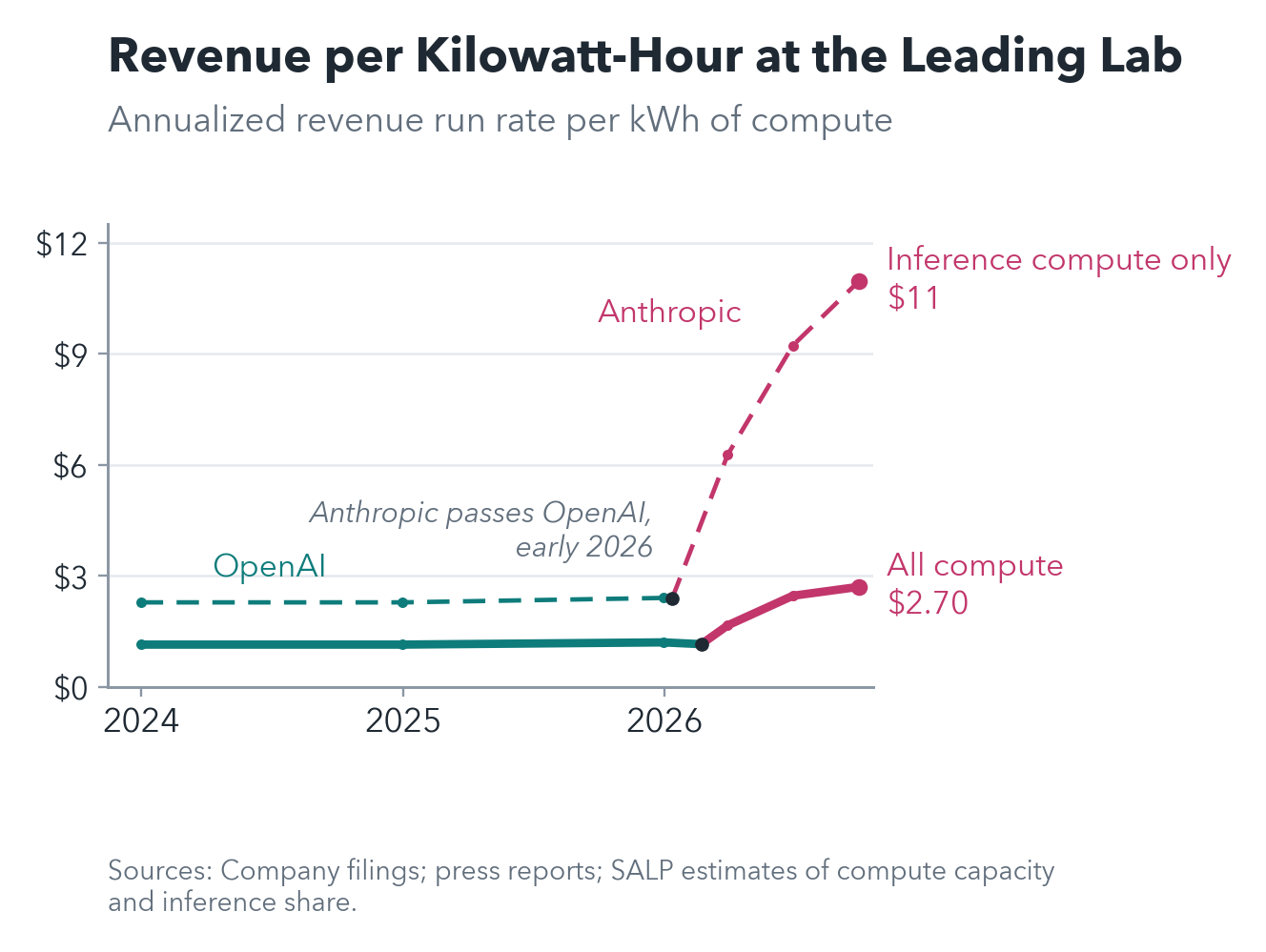
SALP Figure 50 (p. 99). Redrawn from Situational Awareness LP, Q3 2026 investor letter.
Figure 50 plots two separate series, each stitched together from OpenAI through 2025 and handing off to Anthropic in 2026: a lower "All compute" line (revenue spread across all chips, training and inference combined) and a higher "Inference compute only" line (revenue spread only across chips serving paying users). On Figure 50 right underneath the prose, the spliced "All compute" series starts near $1.16 in early 2026 and finishes at $2.70—a rise of roughly 2.3x ($2.70 divided by $1.16 is 2.33), not 4x.
Only the "Inference compute only" line rose four- to fivefold (from ~$2.40 to ~$11, roughly 4.6x, called "~5x" in Footnote 48); the prose appears to attach the inference line's multiplier to the all-compute line's endpoint. Both plotted endpoints ($2.70 and $11) are genuinely rising, and because Anthropic earned less per kilowatt-hour than OpenAI through 2025, an unplotted January 2026 Anthropic starting point could theoretically sit below $1.16. Because Figure 50 never plots Anthropic before the handoff, however, the chart beneath the sentence shows ~2.3x, not "quadrupled."
18. The ">45x more code per engineer" headline is SALP's own estimate—and the companion chart switches units midstream
On pages 10 and 18, SALP reports as a plain fact that at Anthropic, "code shipped per engineer is >45x higher than its 2024 rate." Figure 9's caption (page 21) adds that this lets "a few thousand engineers at Anthropic to ship more code than an organization of ~100,000 engineers." Next to it, Figure 9(b) shows daily code merges into Anthropic's main codebase climbing past 30,000 per day in September 2026.
Three details recalibrate that headline. First, the headline figure does not come from Anthropic's own chart data. On Figure 9(a) (page 21), the last data point sourced from Anthropic is 8.0x; the >45x point leaps 5.6x higher in a single quarter as an open circle labeled "Open marker: SALP estimate for Q3 2026." (Seven pages later, Footnote 17 says Anthropic's IPO filing discloses merging ">45x as much code as they used to"—which either conflates company-wide total merges with per-engineer output, or contradicts Figure 9(a)'s "SALP estimate" label.) Using Anthropic's last reported 8.0x point instead of SALP's 45x estimate, a few thousand engineers equates to roughly 15,000 to 25,000 engineers, not 100,000.
Second, on Figure 9(b), Anthropic changed how it counts code submissions midstream: around June 2026, following an internal source-control redesign, the chart switches from "Pull requests" (standard code-review batches) to "Antique change requests"—right before most of the surge occurs—without showing that the two units represent comparable amounts of work. Third, page 28 itself concedes that when computing power for running experiments is scarce, "researchers can write 50x as many lines of code but only end up running ~2x as many experiments," undercutting raw code volume as a measure of research progress. The upward trend is likely real and unit inflation is unproven, yet stating ">45x per engineer" as an established lab disclosure outruns the exhibit.
19. A caption saying "one-fifth" over a chart that uses one-third—built on a U.S. rate applied to global wages
SALP's "white collar diffusion" route to $1 trillion in 2027 revenue (pages 44–45) extrapolates from software coding to the rest of office work. First, the letter estimates how intensely software already spends on AI: taking roughly $90 billion in annualized global AI coding spend and adjusting for a 71% U.S. share, SALP calculates that U.S. AI coding spend equals about 10% of the $632 billion U.S. software wage bill (Footnote 24). Page 44 then applies that 10% coding benchmark to an estimated ~$30 trillion global white-collar wage bill ("with about $10T in the US," Footnote 25). If broader white-collar work adopts AI at one-fifth of coding's intensity—2% of wages—that yields $600 billion in revenue; at coding's full 10% intensity, it yields $3 trillion. Directly below, however, Figure 25's caption (page 45) states that white-collar adoption reaches $1 trillion at "~one-fifth the intensity that coding has."
SALP Figure 25 (p. 45). Redrawn from Situational Awareness LP, Q3 2026 investor letter.
Three slips cluster within half a page. First, the caption disagrees with both the prose above it and the chart right beneath it. Page 44 just computed that one-fifth of coding's intensity (2% of $30 trillion) is $600 billion, not $1 trillion; inside Figure 25 itself, the chart reaches $1 trillion using "about 3%" ($1 trillion divided by $30 trillion is 3.33%)—roughly one-third of coding's 10% intensity, about 1.67 times higher than its own caption claims.
Second, that 10% benchmark is a U.S.-only adoption rate applied uniformly to $30 trillion of global wages, even though Footnote 24 notes that 71% of Anthropic's revenue comes from the United States. Adjusting for lower non-U.S. adoption trims the $600 billion estimate by roughly a quarter to a half (to about $280 billion–$450 billion). Third, even the "about $10T" U.S. white-collar wage bill contradicts Footnote 25's own arithmetic: taking 46% (the remote-work wage share from economists Dingel and Neiman) of $15.7 trillion in 2025 U.S. compensation equals $7.22 trillion (0.46 times $15.7 trillion), nearly 30% below $10 trillion. Page 44's wide $600 billion to $3 trillion range preserves the broad directional intuition, even though the local arithmetic on the page does not reconcile.
What a Systematic Check Actually Gives You
Stepping back from the individual catches, the pattern matters more than any single slip. None of these findings is a scandal, and together they do not prove that Situational Awareness LP's overarching bet on artificial intelligence is wrong. A document can mislabel a 2.3x climb as a quadrupling, drop a term in a conversion formula, or skip how superintelligence flows through to shareholders and still end up directionally right about the technology. What these nineteen issues show is what accumulates in almost every long, chart-dense analytical document that weaves sixty-plus figures into dozens of interlocking arguments: headline prose running ahead of its own fine print, models in different chapters disagreeing markedly, the same prices differing by 60%+ across fifty pages, and algebraic slips surviving untouched.
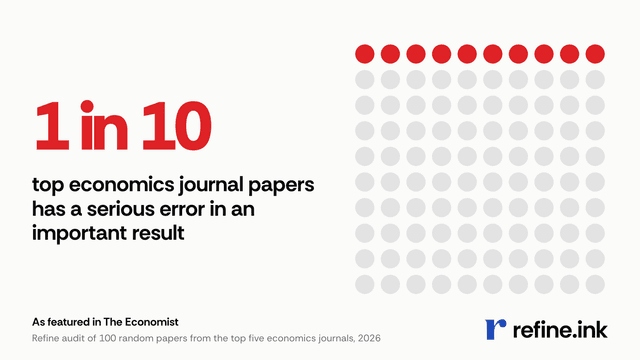
This verification gap extends far beyond hedge funds. In Refine's November 2026 audit of 100 peer-reviewed papers from the top five economics journals, one in ten carried a serious error bearing on an important result—not because authors or referees were careless, but because sustaining line-by-line attention across a dense technical document is brutally hard for human readers, even with typical AI use. Investment memos, policy reports, and strategy letters face the exact same problem, often with billions of dollars riding on the conclusions.
That is the job Refine was built for: a multi-stage verification harness that reads across an entire document—conceptual arguments, economic logic, formulas, footnotes, and figures—tests and filters its own candidate criticisms, and returns specific, passage-anchored issues worth checking. Already used in publication workflows by the American Economic Association and the Econometric Society—as well as by researchers at universities, policy institutions, consultancies, and investment firms—Refine brings the same disciplined check to any long analytical document consequential enough to merit the best in diligence. It clears away preventable inconsistencies and unexamined assumptions so authors, analysts, and investors can spend their judgment where it actually counts.
If you write or rely on high-stakes technical documents and want to stress-test them before they go out—or before you act on them—you can learn more at refine.ink.
Appendix: A One-Page Summary of the SALP Q3 2026 Letter
An overview of Situational Awareness LP's 167-page Q3 2026 investor letter ("Letter 5," November 24, 2026), written by founder Leopold Aschenbrenner's San Francisco hedge fund.
Core Thesis & Performance
Aschenbrenner argues that Silicon Valley AI labs and Wall Street occupy opposite worlds—the widest disconnect since ChatGPT. Inside frontier labs, AI models now accelerate AI research itself, putting superintelligence on track for 2028, while financial markets price AI stocks as if progress is stalling.
Launched in November 2024 with over $100 million, SALP opened 2026 above $4 billion in net asset value and grew nearly tenfold through June (~90% from trading gains). A severe July selloff produced a 67% net monthly loss (−65.0% net in Q3), leaving SALP up 88.5% year-to-date and 477.6% cumulatively after fees through September 30, 2026 (691.9% gross).
Part I: The Gap Between the Markets and the Labs
- Recursive self-improvement (Ia): After five years of ~10x annual growth in effective compute (~3x from hardware, ~3x from algorithms), SALP argues that algorithmic progress is now accelerating as AI agents automate lab research. Citing >45x 2024 code output per engineer and 19 agent hours per researcher hour at Anthropic, it projects 2–6 years (median: 3) of 2024-equivalent progress in 2027, followed by AI-driven chip and factory scaling ("physical RSI") and superintelligence in 2028.
- "Virtual departments" (Ib): Supervised coding assistants will give way to "highly persistent multi-agent" (HPMA) swarms that coordinate for weeks under their own AI managers, expanding from math and software into general white-collar work in 2027.
- $1 trillion in revenue (Ic): Wall Street forecasts $120 billion–$200 billion for Anthropic by late 2027 (up from the $81 billion October 2026 run rate cited by SALP). SALP calls Q3's slowdown routine lumpiness and expects combined lab revenue above $1 trillion—either through modest adoption across ~$30 trillion in global white-collar wages, or through ~$20 million/year in spending from 50,000 heavy users.
- Safety and "pacing" (Id): Treating technical scaling as assured, SALP flags political backlash to cyber misuse or rogue agents as the main risk. Regulatory "pacing" could slow 2027 from ~3x to ~2x (still far above market forecasts), with a ~10% tail risk of a full shutdown; datacenter opposition and higher borrowing costs are treated as manageable.
- Bearish pricing (Ie): After 60%–70% drops in AI-winner and tech-momentum stock baskets, SALP argues markets are pricing in just 0.3–0.6x of a normal progress year, valuing memory makers near one times SALP's 2027 earnings estimates and datacenters near the value of already-signed contracts.
Part II: Investing in the Singularity
- Sequence of bottlenecks (II, Appendix A): Rather than holding Nvidia alone, SALP rotates across successive supply bottlenecks: power turbines and fuel cells (Siemens Energy, Bloom Energy), optical links (Lumentum), memory chips, datacenter builders (Fluidstack), and frontier AI labs.
- Anthropic (IIa): First backed at a $60 billion valuation in early 2025 (up ~14.8x to its November 2026 IPO), SALP's largest holding anchors its view of labs as high-margin "jet engine makers" rather than commodity "airlines." SALP cites ~85%–86% inference gross margins (43% including training) and argues Anthropic could lead global profits by late 2027.
- Memory, spot compute, and robotics (IIb–IId): Because reasoning models and agents bottleneck on working memory (DRAM) and flash storage (NAND), SALP backed Kioxia, Sandisk, and SK Hynix (up 16-fold before falling two-thirds, per SALP). It also projects short-term ("spot") server rental prices rising from ~$1/kWh historically and ~$4–$5.50/kWh today toward $100s/kWh+ (backing SpaceX, Nebius, and Sharon AI), alongside a potential 2027 "ChatGPT moment for robotics."
- Artificial superintelligence (ASI) over artificial general intelligence (AGI) (IIe): Superhuman AI will quickly obsolete corporate intellectual property, workforces, and even incumbent "AI winners" (Nvidia, Microsoft, Apple, ASML, Eli Lilly, Tesla)—destroying ~$500 trillion in existing value while creating >$500 trillion. That logic favors assets with fast cash payback or irreproducible scarcity like the Mona Lisa.
Parts III & IV: July Postmortem, Portfolio Posture, and Outlook
Aschenbrenner accepts responsibility for July's near-existential crisis. Entering the month roughly 1.6x long and 1x short on prime-broker borrowing, SALP was hit by crowded selloffs, lagging hedges, surging software shorts, and vanishing liquidity—forcing a July 29–30 block trade that closed all shorts and cut public long positions in half.
Now in "dry dock" (accepting no new capital) and back to roughly 70% public and 30% private holdings after Anthropic's IPO, SALP holds fully paid-for stocks and options with no short selling or borrowed leverage. Its 28-person team (up from 3) adds veteran compliance, legal, finance, treasury, and operations staff—including preclearance rules addressing Aschenbrenner's wife serving as Chief of Staff to Anthropic's CEO—alongside a Chief Risk Officer search and internal Claude tooling. Either SALP or the market, he concludes, will have "an extraordinary amount of egg on the face in a year," making 2027 potentially "the last year that feels vaguely normal."
Footnotes
-
See Alex Imas, “What will be scarce?”, Ghosts of Electricity, April 14, 2026, especially “From farms to factories to…,” on how automation changes relative prices and reallocates spending and labor; and Alex Imas and Soumitra Shukla, “How Will AI-driven Automation Actually Affect Jobs?”, March 23, 2026, especially “How can automation raise wages?” and “But this is not necessarily good news for labor,” on wage responses and the role of falling output prices and demand. These mechanisms do not establish a particular future wage or robot-cost path; they explain why holding current wages fixed is insufficient. ↩
More posts
An AI-assisted audit of 100 papers from the top five economics journals
The data behind The Economist’s Free Exchange column: one in ten of 100 random 2026 papers from the top five economics journals has a serious error bearing on an important result.
Refine 5 beats GPT-6 Astra and Claude Fable 5.1 at paper review
On 108 papers in ten fields, from macroeconomics to genomics and statistical physics, Refine 5 won 197 of 215 matches.
A Retrospective Math Benchmark
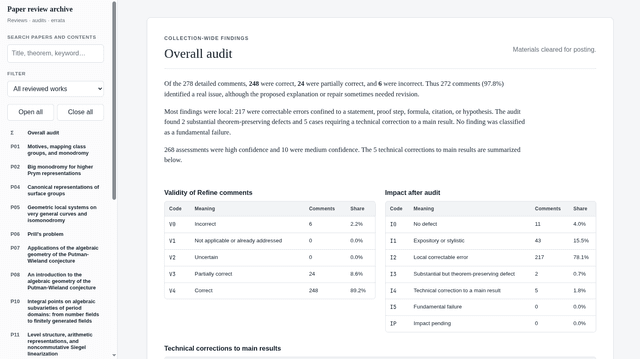
Mathematician Daniel Litt ran 20 of his papers through Refine. Of the 278 comments it generated, 97.8% pointed to a real issue that coauthors, referees, and editors had missed.