Refine has completed its SOC 2 Type 1 examination
Refine has completed its SOC 2® Type 1 examination and received its first SOC 2 report — an important step in our ongoing commitment to protecting researchers and their work.
An important milestone
Protecting the work researchers entrust to Refine has been a priority from the beginning. Today, we are pleased to share that we've reached an important milestone in that journey: Refine has completed its System and Organization Controls (SOC) 2® Type 1 examination and received its first SOC 2 report.
Why it matters
Researchers may upload unpublished papers, early-stage ideas, and other work that is not yet ready to be shared publicly. We understand the trust involved in submitting that material to Refine, and we take the responsibility seriously.
The examination evaluated the design of the controls we have in place to protect our systems and the information processed through the Refine platform. For our customers and institutional partners, the report provides independent assurance that security is being built into the way Refine operates.
What's next
Completing our SOC 2® Type 1 examination is an important milestone in our ongoing commitment to security. We will continue investing in the systems, policies, and practices that help protect our customers and their work.
We're grateful to Prescient Security for conducting the examination and supporting us throughout the process.
For additional information about Refine's security practices, visit our Trust Center.
About the author

More posts
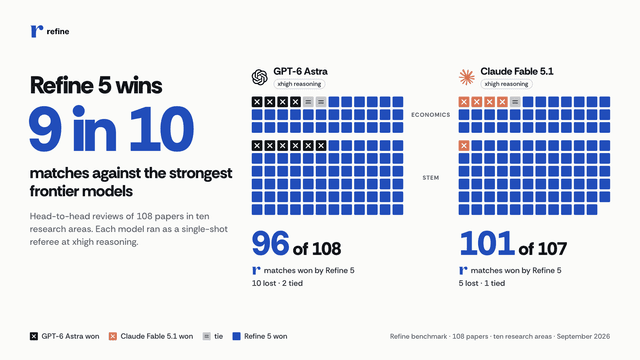
Refine 5 beats GPT-6 Astra and Claude Fable 5.1 at paper review
On 108 papers in ten fields, from macroeconomics to genomics and statistical physics, Refine 5 won 197 of 215 matches.

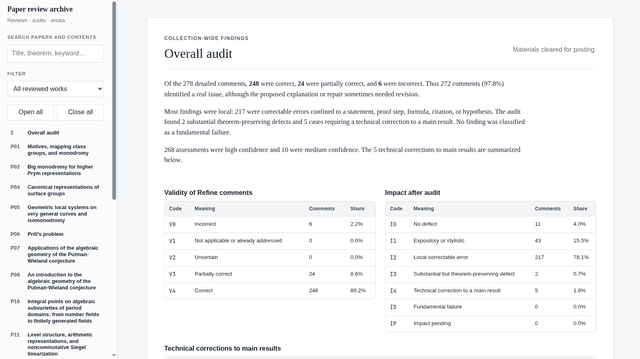
A Retrospective Math Benchmark
Mathematician Daniel Litt ran 20 of his papers through Refine. Of the 278 comments it generated, 97.8% pointed to a real issue that coauthors, referees, and editors had missed.

Refine partners with the American Economic Association and the Econometric Society
Two leading publishers in economics now use Refine's AI-assisted technical verification as part of their publication processes.